
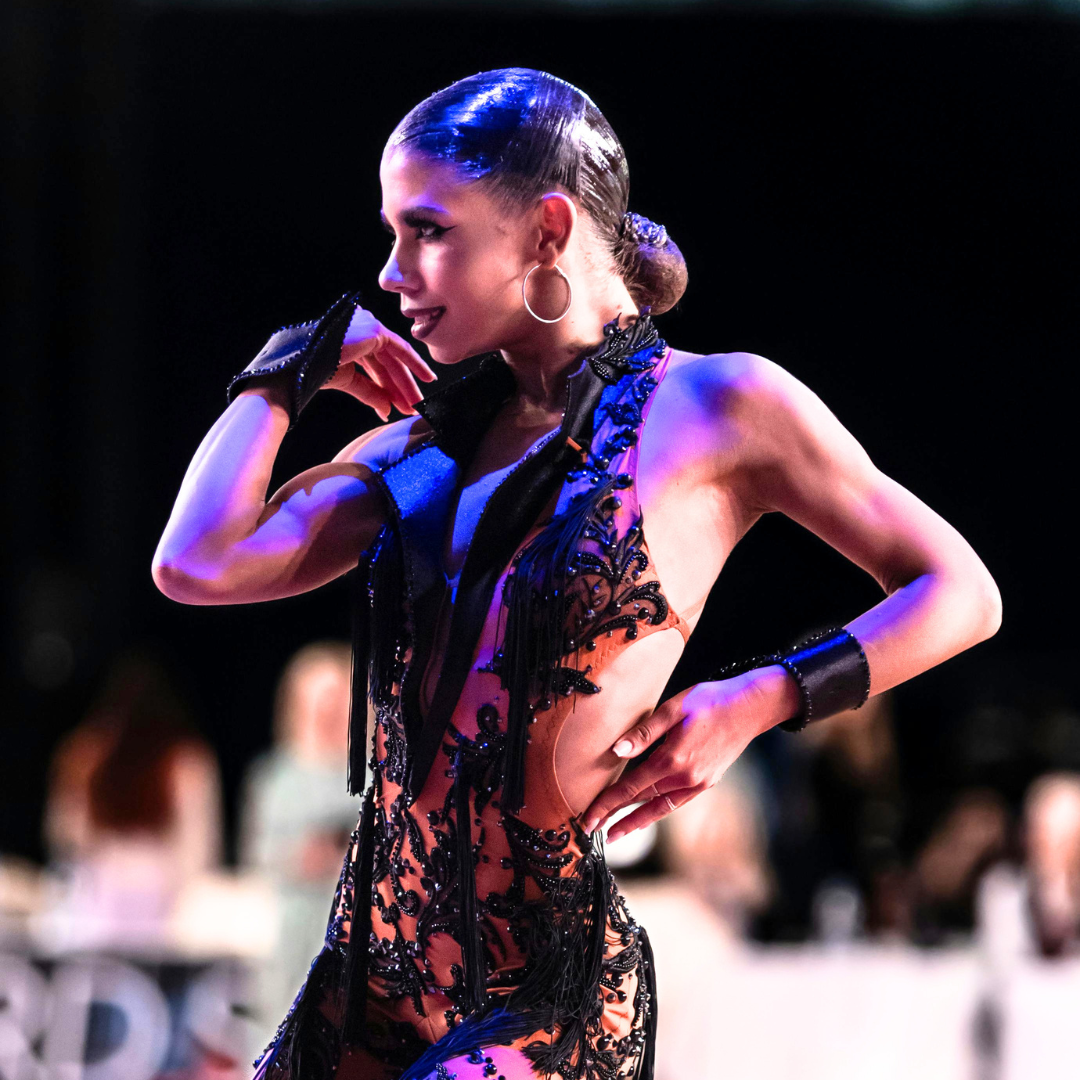
You survey the dressing room while hundreds of dancers from all over the state (and from outside!) prepare for their group routines. Then, your gaze shifts to your dancers. They look…terrified.
One dancer is obsessively marking her choreography, another dancer is bouncing from one foot to another while chewing a granola bar, and your lead dancer is doing…nothing. She is staring into space like a deer in headlights. Oh boy, you think, this is going to be a learning experience.
The global dance competition industry was valued at $1.2 billion in 2025, according to Market Intelo. And we can all assume that it will continue to grow significantly in the future. In short, competitions (and conventions) are a thing. And, if you’re a dance educator who is taking your dancers to one of these increasingly popular events, it’s important to know how they impact your dancers’ mental wellness.
The challenge with competition

Cultivating a healthy dancer mindset before competition
So, how do we encourage our dancers to try their best, but not tie their self-worth to the outcome of a competition? First of all, it’s difficult. And as a dance educator, you should know that you won’t always be successful. But there are a few things you can do to set up a healthy environment for learning and (hopefully a little bit of) fun.
You can attempt to shift dancers’ mindset before leaving for competition. Obviously, pursuing platinum is an extrinsically motivated goal. The dancer (or you!) can’t control what score dance competition judges give them. But, if you replace the goal of “winning” with a goal that can be accomplished, win or not, that puts the power back in the dancer’s hands.
Before leaving for competition, you can encourage dancers to set their own standards of achievement. They can set the bar for a particularly emotionally engaged performance, they can aim to focus more on their placement, or they could even just set a goal to have fun. All of these things can be accomplished with focus and dedication, independent of a judge’s scores. In this situation, instead of competing against others, dancers can focus on competing against themselves.
David Villa says in Forbes Magazine that, “In my eyes, the definition of a winner is someone who gives 100% of their effort in preparation for and during competition 100% of the time, regardless of the circumstances faced before them. Winning involves more than beating an opponent or the final score on the board. A person can be a winner as long as they give everything they’ve got.”
So, when dancers create and achieve their own goals, it doesn’t matter how much a judge likes you or whether they win a platinum. When they compete against themselves, hard work is the only determinant of their success.
Creating a healthy mindset during competition
Dance competitions and conventions are great for inspiring dancers and jolting them out of a routine and into a burst of improvement and motivation. They can also be scary. When dancers travel to a competition, they enter into a new space in (potentially) a new city with new teachers and new classmates. They are challenged with new dance styles on a new schedule with higher stakes and increased expectations.
All of this newness can be perceived by dancers as a threat. And this perceived threat can cause dancers’ amygdalae to fire. The amygdala is the part of the brain involved with how we experience emotions related to fear and it is famously credited with the fight, flight, or freeze reaction to a stressful situation.
When the amygdala fires, the brain and the body kick in with multiple physiological reactions, such as rapid heartbeat and breathing, and trembling or shaking. These symptoms both increase oxygen to the body and prime the muscles for action — which was great in the caveman days when we needed to run from a bear. They’re not so great when we want to balance on one foot during an eight-count développé.
But this reaction to fear, or a perceived threat, can also take away from dancers’ ability to process more subtle relational cues. And it makes it more difficult for them to learn. They don’t often see or hear clearly because their bodies are trying to run from the bear rather than soak up inspiration from a convention class centered around waacking.
A good way to get doe-eyed dancers to refocus on learning (rather than running from that bear) is to encourage them to focus on the present. The 5–4–3–2–1 Exercise is a coping technique for anxiety and it’s an easy one to incorporate when you’re in a competition situation. Here’s how you can try it:
First, try to calm your breathing. Find a comfortable place to sit and relax as much as possible. Then, one by one, focus on the following things:
The University of Rochester Medical Center’s website says, “This five-step exercise can be very helpful during periods of anxiety or panic by helping to ground you in the present when your mind is bouncing around between various anxious thoughts.”
Bringing dancers’ attention to the sensory aspects of their surroundings can take away that fear that can get in the way of performing, learning, and (most importantly) having fun.
All of this newness can be perceived by dancers as a threat. And this perceived threat can cause dancers’ amygdalae to fire. The amygdala is the part of the brain involved with how we experience emotions related to fear and it is famously credited with the fight, flight, or freeze reaction to a stressful situation.
When the amygdala fires, the brain and the body kick in with multiple physiological reactions, such as rapid heartbeat and breathing, and trembling or shaking. These symptoms both increase oxygen to the body and prime the muscles for action — which was great in the caveman days when we needed to run from a bear. They’re not so great when we want to balance on one foot during an eight-count développé.
But this reaction to fear, or a perceived threat, can also take away from dancers’ ability to process more subtle relational cues. And it makes it more difficult for them to learn. They don’t often see or hear clearly because their bodies are trying to run from the bear rather than soak up inspiration from a convention class centered around waacking.
A good way to get doe-eyed dancers to refocus on learning (rather than running from that bear) is to encourage them to focus on the present. The 5–4–3–2–1 Exercise is a coping technique for anxiety and it’s an easy one to incorporate when you’re in a competition situation. Here’s how you can try it:
First, try to calm your breathing. Find a comfortable place to sit and relax as much as possible. Then, one by one, focus on the following things:
- Find and identify five things you see around you. Really see them.
- Find and identify four things you can feel (i.e. the fabric of your pants on your legs, your hair on your neck, etc).
- Find and identify three things you can hear.
- Find and identify two things you can smell (i.e. your deodorant, fresh coffee in the kitchen, your pets, etc).
- Find and identify one thing you can taste (i.e. your lunch or your toothpaste).
The University of Rochester Medical Center’s website says, “This five-step exercise can be very helpful during periods of anxiety or panic by helping to ground you in the present when your mind is bouncing around between various anxious thoughts.”
Bringing dancers’ attention to the sensory aspects of their surroundings can take away that fear that can get in the way of performing, learning, and (most importantly) having fun.
Final Thoughts
References
Michelle Loucadoux, co-founder Danscend
Michelle Loucadoux (Fraser) is a former professional dancer turned educator and one of the co-founders of Danscend. She is one of the co-chairs of the dance division at AMDA college is Los Angeles and travels the world speaking to dancers and dance educators about the importance of dancer mental health awareness.

Get in Touch!
hello@danscend.com
Phone number: 213-770-1226
hello@danscend.com
Phone number: 213-770-1226
Copyright © 2026